When two iconic worlds collide, the strategic chaos of Supercell’s Clash Royale and the timeless creativity of LEGO, you get something remarkable. Whether you’re a veteran player who’s grinded through countless ladder matches or a LEGO enthusiast looking to immortalize your favorite mobile strategy game in brick form, this intersection offers endless possibilities. From custom-built arenas that mirror the in-game battlegrounds to meticulously crafted minifigures of the Knight, Hog Rider, and even the elusive Mega Knight, the LEGO Clash Royale community has been building impressive creations for years. This guide dives into everything you need to know about bringing Clash Royale to life with LEGO bricks, from understanding the collaboration history to constructing your own arena, finding custom sets, and even using your builds for content creation. Let’s stack some bricks and crowns.
Table of Contents
ToggleKey Takeaways
- LEGO Clash Royale is a thriving grassroots community of custom MOC (My Own Creations) builds, not an official product line, where fans replicate in-game troops, towers, and entire arenas using LEGO bricks.
- Building a minifigure-scale arena requires planning for scale, color-blocking with earthy tones, and strategic use of pieces like transparent blue plates for rivers and slope bricks for tower details, taking 3–5 hours for first-time builders.
- Essential LEGO pieces for Clash Royale builds include 1×2/2×4 bricks, transparent blue tiles, slope bricks, Technic connectors, and custom minifigure parts from castle-themed sets to replicate iconic troops.
- LEGO Clash Royale builds can be sourced through BrickLink for individual parts, Rebrickable for MOC instructions, Etsy for custom decals, and custom sellers like Brick Warriors for specialized accessories.
- Creating stop-motion animations and shareable content with your LEGO builds drives engagement on YouTube, TikTok, and Reddit, while official LEGO collaboration remains possible in 2027+ as LEGO expands partnerships with gaming franchises.
What Is LEGO Clash Royale and Why Should Gamers Care?
LEGO Clash Royale isn’t an officially licensed product line sitting on store shelves, at least not yet. Instead, it’s a vibrant grassroots movement where fans merge their love for Supercell’s competitive mobile game with the brick-building traditions of LEGO. Players and builders create custom models, or MOCs (My Own Creations), that replicate everything from individual troops and spells to entire battle arenas complete with Crown Towers and King Towers.
Gamers should care because these builds bridge the gap between digital and physical gaming culture. They serve as display pieces, YouTube content fodder, and even tabletop game proxies. For Clash Royale players specifically, building your favorite cards in LEGO form deepens the connection to the game. It’s one thing to drop a P.E.K.K.A in a match: it’s another to assemble one brick by brick and display it on your desk. Plus, with the rise of stop-motion animation and TikTok build videos, LEGO Clash Royale creations have become a legitimate content niche.
The community around these builds is surprisingly active. Platforms like Reddit, YouTube, and dedicated LEGO forums are filled with step-by-step guides, part lists, and inspiration galleries. Some builders even sell instruction sets or custom minifigure decals to help others recreate iconic troops. For a game that’s all about strategy and personalization, LEGO offers the perfect analog companion.
The History Behind LEGO and Clash Royale Collaborations
LEGO and Clash Royale have never had an official partnership announced by either Supercell or the LEGO Group. But, the idea has floated around fan communities since Clash Royale’s global launch in 2016. LEGO Ideas, a platform where fans submit concepts for potential official sets, has seen multiple Clash Royale proposals over the years. While none have reached the 10,000-supporter threshold required for LEGO review (or were passed over during internal evaluation), the submissions showcased incredible creativity, from modular arena builds to minifigure-scale troops.
The absence of official sets hasn’t stopped the community. In fact, it’s fueled a thriving custom market. Builders have reverse-engineered Clash Royale’s art style into LEGO form, creating designs that honor the game’s cartoony aesthetic while working within the constraints of actual LEGO parts. Some early MOCs from 2017-2018 focused on simple troop builds, Knights, Archers, and Goblins, but by 2020, builders were tackling complex structures like the Arena Tower and even multi-level King Towers with working LED lights.
LEGO’s collaboration history with other gaming franchises, like Minecraft, Overwatch, and Super Mario, proves there’s precedent for crossover sets. Fans continue to hope that Clash Royale will eventually join that roster, especially as the game remains a top-grossing mobile title in 2026. Until then, the community fills the gap.
Official LEGO Sets vs. Community-Created MOCs
Official LEGO sets come with guarantees: quality-controlled instructions, verified part compatibility, and brand authenticity. They’re plug-and-play. Community MOCs, on the other hand, are the wild west. Quality varies wildly, some creators offer professional-grade PDFs with part lists and LDraw files, while others post blurry smartphone photos and call it a day.
That said, MOCs have advantages. They’re often more creative and niche than anything LEGO would mass-produce. Want a life-sized Electro Giant or a micro-scale Clan War battlefield? MOCs deliver. They’re also cheaper in some cases, especially if you already own a bulk LEGO collection and just need a few specialty pieces.
The downside? Sourcing parts can be a headache. You’ll spend hours on BrickLink hunting down specific bricks in the right colors. And without official instructions, builds can be frustrating, especially if the designer skipped critical steps or used rare/discontinued parts. Still, for dedicated fans, that’s part of the appeal. Every MOC is a puzzle within a puzzle.
Building Your Own Clash Royale Arena with LEGO Bricks
Constructing a Clash Royale arena in LEGO is one of the most ambitious projects you can tackle. The in-game arena is deceptively complex: two lanes, a river bisecting the battlefield, three towers per side, and environmental details like bridges and decorative elements. Translating that into a stable, displayable build requires planning.
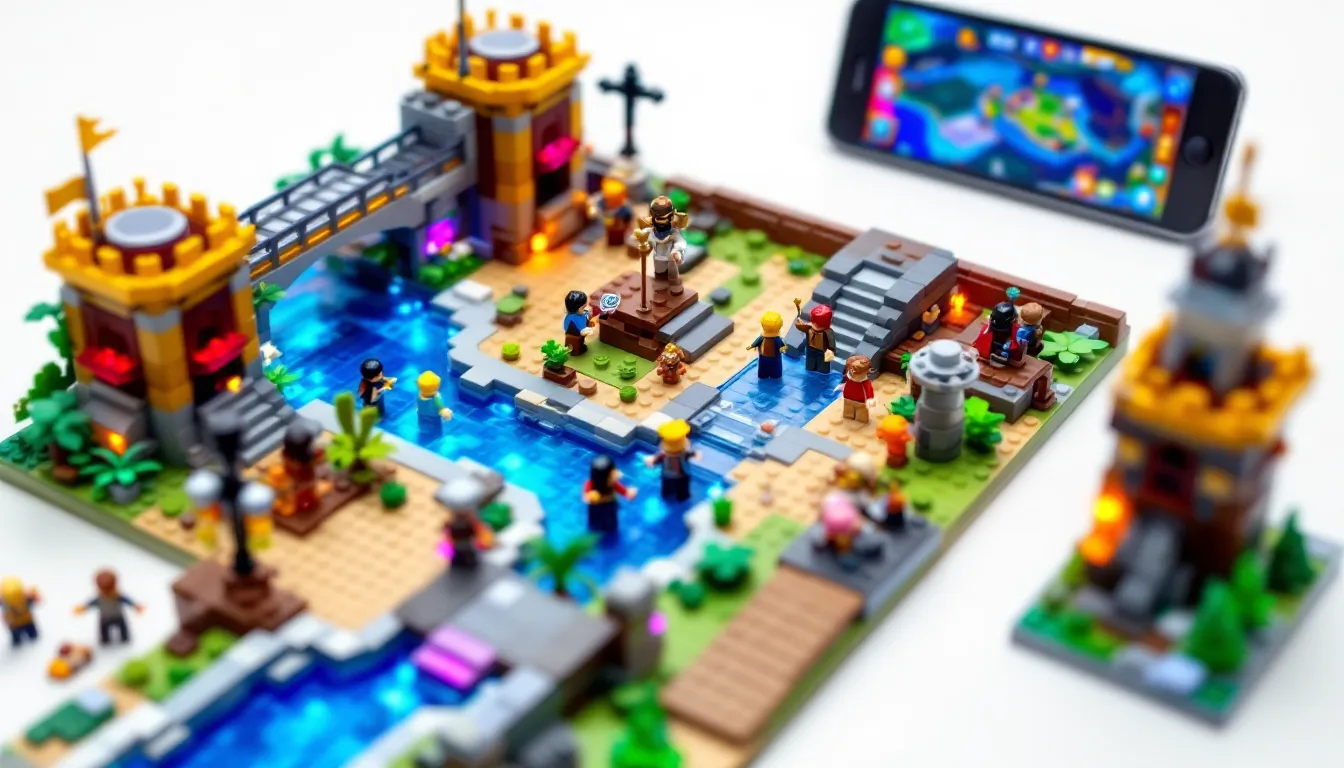
Start by deciding on scale. Minifigure scale (where LEGO people can stand in the arena) is popular but demands a lot of space and bricks. Micro-scale arenas (roughly 16×16 studs or smaller) are more achievable for beginners and still look great on a shelf. Whichever you choose, sketch out dimensions before buying parts. The arena’s 2:1 length-to-width ratio should guide your baseplate selection.
Color blocking is critical. Most arenas use earthy tones, browns, grays, and greens, to replicate grass, stone, and water. For the iconic river, transparent blue plates or tiles work best, layered over a dark blue or black base to create depth. Bridges can be built with arch bricks or simple flat spans, depending on your desired detail level.
Don’t forget verticality. The Crown Towers and King Tower should be visibly taller than the arena floor. Use stacked bricks or LEGO Technic connectors to add height without sacrificing stability. If you’re feeling ambitious, hollow out the towers and add LED strips for a glowing effect, just make sure to plan cable routing early in the build.
One common mistake is overcomplicating early on. Start with a flat arena, get the layout right, then add towers and details. Trying to build everything simultaneously leads to wobbly structures and frustration. Many experienced builders recommend using strategic deck planning principles, focus on your win condition (the arena base), then layer in support (towers, bridges, decorations).
Essential LEGO Pieces for Clash Royale Builds
Not all LEGO bricks are created equal, and certain pieces are MVPs for Clash Royale builds:
- 1×2 and 2×4 Bricks (various colors): The backbone of any structure. Stock up on grays, browns, and tans for towers and stonework.
- Plates (1×1, 1×2, 2×2): Essential for fine detail work, especially on troop minifigures and small decorations.
- Transparent Blue Bricks/Tiles: For water effects. The flatter the piece, the better it mimics the game’s river.
- Slope Bricks (various angles): Roofs, ramps, and decorative accents on towers need angled pieces. 33° and 45° slopes are most versatile.
- Minifigure Parts: Helmets, weapons, and accessories let you customize troops. The Castle and Kingdoms themes have useful medieval gear.
- Technic Pins and Connectors: If you’re building modular sections or want removable towers, Technic parts provide sturdy connection points.
- Cheese Slopes (1×1 rounded tiles): Perfect for adding curved details to helmets or armor on troop builds.
Before ordering, check mobile game building guides for part recommendations, many LEGO builders cross-reference mobile games to get proportions right. BrickLink’s color and part databases are also invaluable: you can filter by availability and price to avoid hunting for rare pieces.
Step-by-Step Arena Construction Guide
Here’s a streamlined build process for a basic minifigure-scale arena (approximately 32×16 studs):
- Lay the Foundation: Use a 32×32 baseplate (you’ll only use half the depth). Mark out a centerline for the river, about 4-6 studs wide.
- Build the River: Stack transparent blue plates or tiles in the center strip. Add dark blue underneath for depth. Leave gaps at the bridges.
- Construct the Bridges: Use 1×6 or 2×6 bricks to span the river at two points (left and right lanes). Arch bricks add style but aren’t required.
- Create the Battleground Tiles: Fill in the playable area on both sides of the river with green, tan, or gray plates. Vary the colors slightly for a less uniform look.
- Build the Towers: Start with a 4×4 or 6×6 base per tower. Stack bricks to about 10-12 bricks high for Crown Towers, 14-16 for the King Tower. Hollow out the interior if you want to add minifigures inside.
- Add Decorative Details: Flags, banners, and small foliage bring the arena to life. Use 1×1 round plates on sticks for torches or campfires.
- Final Touches: Place troop minifigures on the field for a dynamic display. Consider adding elixir collectors or spell effects using transparent colored pieces.
This process takes 3-5 hours for a first-timer, less once you’ve internalized the techniques. Modular construction, building towers separately and attaching them later, speeds things up and makes the build more portable.
Top LEGO Clash Royale Character Builds You Can Make Today
Building individual troops and cards is where LEGO Clash Royale really shines. These smaller projects are perfect for testing techniques, and they double as desk decorations or stop-motion actors. Here’s a breakdown of the most popular and achievable character builds.
Knight and Mini P.E.K.K.A Minifigure Designs
The Knight is Clash Royale’s everyman, cheap, reliable, and mustachioed. In LEGO form, he’s a straightforward minifigure conversion. Start with a standard LEGO knight torso (the Castle theme has plenty), add a gray helmet, and find a black hair piece with a mustache print (or use a custom waterslide decal). Equip him with a sword and a small shield, and you’re done. The key is nailing the pink skin tone and that iconic facial hair.
Mini P.E.K.K.A is trickier. He’s bulkier than a standard minifigure, so many builders use a “bigfig” base (like the Thanos or Hulk molds) or custom-build a slightly oversized body with extra plates. The armor should be dark gray or black, with some metallic silver highlights. His helmet is the signature piece, a rounded, knight-style helm with a single eye slit. Use a 2×2 round brick or dome piece, then add a printed 1×1 tile for the glowing eye. His sword is oversized, so a LEGO claymore or custom-built blade works best.
Both builds benefit from understanding troop counters in-game, knowing which cards are iconic helps prioritize which to build first.
Building Towers, Crown Towers, and King Towers
Towers are the heart of any Clash Royale build. Crown Towers should be symmetrical and placed at the corners of your arena. A simple 6×6 stud base works, with walls built up 10-12 bricks high. Use battlements (1×2 bricks with gaps) at the top to mimic the crenellations seen in-game. Add a flag or banner using a LEGO flag piece and a 1×1 round brick “pole.” Some builders integrate a rotating mechanism using Technic gears, letting the tower “fire” at imaginary troops.
The King Tower is larger and more central. An 8×8 base gives you room to add detail: windows (use transparent 1×2 tiles), a throne room interior (if you’re ambitious), and a more ornate roof. The King himself can be a custom minifigure with a crown piece (plenty in LEGO’s Kingdoms and Castle lines) and a red or purple cape. His tower should be visibly taller and more decorated than the Crown Towers, think gold accents, extra flags, and maybe a working drawbridge.
For players who’ve climbed the competitive ladder, recreating your favorite arena theme (like Builder’s Workshop or Hog Mountain) adds personal flair. Use reference screenshots from the game to match color schemes and architectural details.
Creating Legendary Cards in LEGO Form
Legendary cards are the holy grail of LEGO Clash Royale builds. They’re visually distinct, mechanically interesting, and beloved by fans. Here are three standout projects:
Mega Knight: This absolute unit requires serious brickwork. Start with a bigfig body or build a custom frame using LEGO Hero Factory/Bionicle parts for articulation. The armor is bulky and layered, use stacked plates and slope bricks to create rounded pauldrons. His helmet should be oversized, with a menacing visor (a 2×3 slope brick in dark gray works). Some builders add a spring-loaded mechanism so he can “jump” when you press down on him, mimicking his in-game deploy.
Electro Wizard: Easier to build but detail-intensive. Use a standard minifigure base with a custom-printed torso (or stickers) showing his electric coils. His hair is white and spiked, find a spiky hair piece and paint it, or use a white flame piece. The key detail is his Tesla coils: use 1×1 round transparent blue bricks on his shoulders, connected by thin LEGO string or wire. For extra flair, add LED lights inside the coils.
Sparky: A fan favorite and a fun build. Sparky is essentially a cannon on wheels, so use a 4×4 base with LEGO Technic wheels. The cannon barrel can be a stack of round 2×2 bricks or a LEGO City telescope piece. Add gears and mechanical details using Technic parts, and don’t forget the googly eyes, 2×2 round tiles with eye prints. Some advanced builders motorize Sparky using a LEGO Power Functions motor so she can roll across the table.
If you’re diving into challenge mode strategies and want to immortalize your favorite win condition, Legendary card builds are a rewarding investment of time and bricks.
Where to Find LEGO Clash Royale Sets and Custom Kits
Since official LEGO Clash Royale sets don’t exist (yet), sourcing your builds requires hunting through various channels. The good news? The LEGO aftermarket and custom community are robust and surprisingly accessible.
Online Marketplaces and Community Platforms
BrickLink is the go-to marketplace for individual LEGO parts. It’s a global network of sellers offering new and used bricks, often at pennies per piece. Search by part number, color, and quantity, then compare prices across sellers. The interface is dated but functional. Pro tip: buy from sellers in your region to save on shipping, and bundle orders when possible, some sellers offer discounts for large purchases.
Rebrickable bridges the gap between inspiration and execution. Upload your existing LEGO inventory, then browse MOC instructions that match your available parts. Several Clash Royale arena and troop designs are available here, complete with part lists and step-by-step PDFs. Some are free: others cost $5-15. Quality varies, so check user reviews before buying.
LEGO Ideas is worth monitoring even though Clash Royale projects haven’t succeeded yet. Supporting a proposal can signal demand to LEGO, and browsing the submissions offers inspiration and free design concepts.
Reddit communities like r/lego and r/ClashRoyale occasionally feature MOC showcases. Builders often share techniques and part sourcing tips in the comments. YouTube is another goldmine, channels focused on LEGO gaming builds sometimes tackle Clash Royale, and many include part lists in video descriptions.
For those interested in broader mobile game builds, checking tier lists and meta guides can inform which troops or cards are worth building first.
Custom LEGO Sellers and MOC Designers
A cottage industry of custom LEGO sellers has emerged, offering printed parts, decals, and full instruction sets for niche builds. Here’s where to look:
- Etsy: Search “LEGO Clash Royale” and you’ll find custom minifigure decals, printed tiles (like elixir drops or spell effects), and occasionally full instruction PDFs. Prices range from $3 for decals to $20+ for comprehensive build guides.
- Fiverr and Gumroad: Some MOC designers sell their instructions directly here. These are often higher quality than free options, with detailed renders and part lists optimized for BrickLink ordering.
- Patreon Creators: A few LEGO YouTubers and builders run Patreon pages offering exclusive MOC designs, including gaming-themed builds. Monthly tiers ($5-10) grant access to a library of instructions.
- Custom Minifigure Shops: Sites like Brick Warriors, BrickForge, and Clone Army Customs sell fantasy and medieval accessories perfect for Clash Royale troops, helmets, swords, shields, and even custom-printed torsos.
When buying custom instructions, verify that the designer provides a BrickLink-compatible XML file for easy part ordering. Some sellers skimp on this, leaving you to manually compile a shopping list, a tedious process.
If you’re deep into the Clash Royale ecosystem and experimenting with deck building strategies, consider which cards appear most often in your matches and prioritize building those first.
Displaying and Gaming with LEGO Clash Royale Creations
Once you’ve built your LEGO Clash Royale masterpieces, the next step is showing them off, or putting them to work. Whether you’re a content creator, a collector, or just proud of your builds, there are plenty of ways to maximize their impact.
Display shelves with risers work wonders for tower builds. Arrange your arena on the bottom tier, with individual troop minifigures on higher shelves to create a dynamic, multi-level showcase. Backlighting with LED strips (available cheap on Amazon) adds drama, especially for transparent pieces like rivers or spell effects. If you’ve built modular towers, consider rotating them seasonally or after balance patches, swap out a nerfed card for the new meta king.
For gaming crossover fans, LEGO builds can serve as physical references during matches. Some players keep a P.E.K.K.A or Mega Knight build next to their monitor or phone as a good-luck charm. Others use their arena builds as streaming backdrops, giving their Twitch or YouTube setup a unique, handcrafted aesthetic.
Tabletop gaming is another unexpected use. With a LEGO arena and troop builds, you can create a physical Clash Royale board game. Assign stats to each minifigure, use dice for RNG elements, and invent turn-based rules. It’s not official, but it’s a fun way to engage friends who don’t play the mobile game. Players who’ve mastered tower customization in-game often enjoy replicating their favorite skins in LEGO form.
Tips for Photographing and Sharing Your Builds Online
Good photography separates amateur build pics from viral posts. Here’s how to level up:
- Lighting is everything. Natural light from a window (indirect, diffused) beats harsh overhead bulbs. For nighttime shoots, use a ring light or two desk lamps positioned at 45° angles.
- Background matters. A plain white or black backdrop (poster board works) keeps focus on the build. Avoid cluttered desks or busy patterns.
- Use depth of field. If your phone or camera allows, blur the background slightly to make the LEGO build pop. Portrait mode on modern smartphones does this automatically.
- Shoot multiple angles. Front, side, top-down, and close-ups of details. Variety keeps viewers engaged.
- Add context. Place a phone or tablet showing Clash Royale gameplay next to the build for a cool comparison shot.
- Edit minimally. Boost contrast and saturation slightly, but don’t over-process. LEGO’s colors are vibrant enough on their own.
When sharing on Reddit or Instagram, mention your part count, build time, and any custom techniques. Communities love specifics. Hashtags like #LEGOMOCs, #ClashRoyale, and #LEGOGaming improve discoverability. If you’re posting to r/ClashRoyale, time your post for peak hours (evenings US Eastern time) to maximize upvotes.
Using LEGO Builds for Stop-Motion Animation and Content Creation
Stop-motion animation turns static builds into dynamic stories. Apps like Stop Motion Studio (free, iOS/Android) make this easier than ever. Set up your arena, position your troop minifigures, and shoot frame by frame, move a piece slightly, snap a photo, repeat. At 12-15 frames per second, a 30-second clip takes about 300-400 photos. Tedious? Yes. Worth it? Absolutely.
Popular video ideas include:
- Recreating famous Clash Royale moments: That insane clutch with Rocket, a Mega Knight jump, or a Hog Rider rush.
- Build timelapse: Speed up your construction process and overlay game music. These perform well on YouTube Shorts and TikTok.
- Card showcases: Introduce a new LEGO troop build with a mock “card reveal” animation, mimicking the in-game chest-opening sequence.
- Battle simulations: Stage a full match with two players’ decks. Add sound effects ripped from the game (use royalty-free alternatives to avoid copyright strikes).
For audio, Epidemic Sound and Artlist offer game-friendly music. Clash Royale’s sound effects are copyrighted, but fan-made recreations exist on sites like Freesound.org. Always check licensing before monetizing.
Content creators who’ve tackled Triple Elixir strategies often find that chaotic, fast-paced stop-motion mirrors the in-game mode’s energy, quick cuts, lots of action, minimal downtime.
The Future of LEGO and Gaming Crossovers in 2026 and Beyond
As of early 2026, LEGO has continued expanding its gaming partnerships. The success of sets like LEGO Super Mario, Minecraft, and the Overwatch 2 line proves that gamers are willing to spend on brick-built versions of their favorite digital worlds. Clash Royale, with its massive player base and iconic visual style, remains a prime candidate for official collaboration.
Industry insiders point to LEGO’s increasing focus on mobile and live-service games. Fortnite got a LEGO mode in late 2023: Roblox has unofficial LEGO-compatible kits: even Genshin Impact has been floated as a potential partner. Supercell’s portfolio, Clash Royale, Clash of Clans, Brawl Stars, offers diverse building opportunities, and the company’s family-friendly branding aligns with LEGO’s values.
That said, licensing deals take years to negotiate. Even if LEGO and Supercell started talks today, sets wouldn’t hit shelves until 2027 at the earliest. In the meantime, the MOC community will continue filling the gap, likely with even more sophisticated designs as building techniques evolve.
One trend to watch: LEGO digital integration. The LEGO Builder app now includes AR features and step-by-step 3D instructions. Imagine scanning your physical Clash Royale arena and seeing troop animations overlaid in augmented reality, or unlocking in-game cosmetics by completing LEGO builds. Cross-promotion between LEGO and Supercell could drive engagement for both brands.
Another possibility is modular, expandable sets. Instead of one massive Clash Royale arena kit, LEGO could release smaller booster packs, troop bundles, spell effect add-ons, or alternate arena themes. This approach mirrors how players build decks in-game and would encourage repeat purchases.
For builders invested in trading and collecting strategies, a physical LEGO component could add a tangible dimension to the hobby, swapping rare minifigure parts the way you’d trade cards in-game.
The broader gaming LEGO landscape is heating up. Expect more collaborations, better integration between physical and digital play, and a growing recognition that adult gamers are a lucrative LEGO demographic. Clash Royale fits perfectly into that future.
Conclusion
LEGO Clash Royale sits at the intersection of two passionate communities, mobile strategy gamers and brick-building enthusiasts. While we’re still waiting on an official partnership, the MOC scene has already proven that Clash Royale translates beautifully into physical form. From intricate arena builds to stop-motion battle recreations, the possibilities are limited only by your brick collection and imagination.
Whether you’re constructing a display piece to celebrate your favorite legendary card, creating content for YouTube, or just looking for a weekend project that merges your hobbies, the techniques and resources in this guide should get you started. The community is welcoming, the learning curve is manageable, and the results are genuinely rewarding.
So grab your BrickLink shopping cart, fire up LDD or Stud.io, and start building. Your LEGO Clash Royale kingdom awaits, one brick, one troop, one tower at a time.